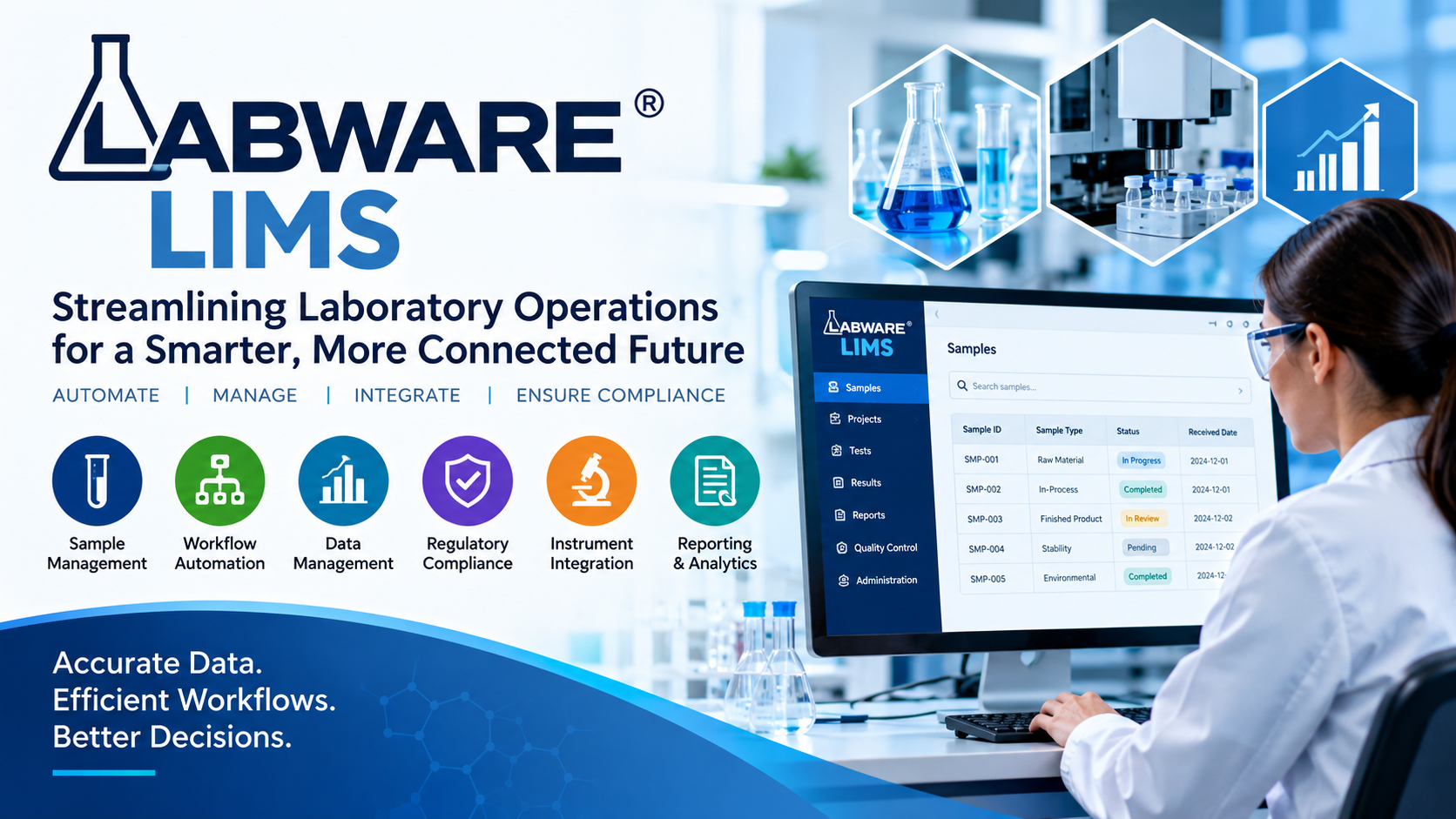
Modern laboratories operate in an environment where accuracy, efficiency, traceability, and regulatory compliance are essential. Whether working in pharmaceuticals, biotechnology, chemicals, environmental testing, food manufacturing, or healthcare, laboratories generate substantial volumes of information that must be recorded, processed, reviewed, and maintained throughout the testing lifecycle.
Traditional laboratory management methods involving spreadsheets, paper-based documentation, and disconnected software applications often create operational challenges. These include manual data entry errors, delayed reporting, inconsistent workflows, limited sample visibility, and difficulties maintaining complete audit trails.
Laboratory Information Management Systems (LIMS) address these challenges by providing centralized platforms for managing laboratory processes and associated information.
Among the established solutions in this field, LabWare LIMS provides capabilities for laboratory workflow management, sample tracking, analytical data management, quality assurance, and integration with enterprise systems.
LabWare LIMS helps organizations coordinate laboratory activities, standardize procedures, improve data reliability, and support compliance requirements. Its configurable architecture allows laboratories to adapt the platform to their operational processes while maintaining structured control over laboratory information.
As industries increasingly adopt digital laboratory technologies, understanding LabWare LIMS has become valuable for laboratory analysts, quality professionals, system administrators, implementation consultants, and IT specialists.
1. What Is LabWare LIMS?
LabWare LIMS is a Laboratory Information Management System designed to organize, automate, and manage laboratory operations throughout the sample testing lifecycle.
The platform supports laboratory activities ranging from sample registration and test assignment to result entry, review, approval, and reporting.
Rather than managing laboratory information across multiple disconnected applications, organizations can use LabWare LIMS to maintain structured records within a centralized environment.
The system is designed to support complex laboratory requirements, including multiple testing departments, laboratory locations, analytical methods, and regulatory procedures.
Core functions of LabWare LIMS
- Sample registration, identification, and tracking
- Test assignment and analytical workflow management
- Laboratory result recording and verification
- Instrument and enterprise system integration
- Quality control and laboratory process monitoring
- Electronic records and audit trail management
- Laboratory reporting and data retrieval
- User access and security management
- Laboratory resource and operational coordination
LabWare LIMS can be configured to accommodate laboratory-specific processes, enabling organizations to standardize activities without relying entirely on manual administrative procedures.
2. Why Laboratories Need a LIMS Solution
Laboratories must manage interconnected activities while maintaining reliable records and meeting demanding turnaround expectations.
A single sample may undergo multiple analytical procedures, require approval from different personnel, and generate numerous results before its final disposition.
Without an integrated management system, coordinating these activities becomes increasingly difficult.
Challenges associated with traditional laboratory management
Manual data entry: Repeatedly entering information into spreadsheets or paper records increases the possibility of transcription errors.
Limited sample visibility: Laboratory personnel may struggle to determine the current status, location, or testing progress of individual samples.
Delayed result processing: Manual review and approval procedures can extend testing turnaround times.
Inconsistent procedures: Different departments may follow variations of the same laboratory process, affecting standardization.
Compliance difficulties: Maintaining complete, traceable, and retrievable records can become challenging when information is distributed across multiple systems.
LabWare LIMS addresses these operational issues by providing controlled workflows, centralized information, and automation capabilities.
Its implementation can help laboratories reduce administrative effort, improve process visibility, and establish more consistent testing practices.
3. Key Features of LabWare LIMS
LabWare LIMS offers a broad range of functionalities designed to support routine laboratory activities and specialized analytical processes.
3.1 Sample Management and Tracking
Sample management is one of the fundamental capabilities of LabWare LIMS.
Laboratories can register incoming samples, assign unique identifiers, capture sample-related information, and monitor testing activities throughout the sample lifecycle.
Depending on the configured workflow, sample information may include collection details, sample type, testing requirements, priority, storage conditions, and associated projects or batches.
The system helps laboratory personnel identify pending activities and monitor sample progress.
This improves traceability and reduces the likelihood of samples being overlooked during processing.
3.2 Laboratory Workflow Automation
Laboratory workflows frequently involve repetitive activities such as test assignment, status updates, result review, and approval routing.
LabWare LIMS supports the configuration of workflows that guide samples through predefined laboratory processes.
For example, when a sample is registered, the system can be configured to associate relevant testing requirements and route activities to designated laboratory personnel.
Workflow automation helps reduce manual coordination while supporting procedural consistency.
3.3 Test and Result Management
Analytical testing generates information that must be recorded accurately and evaluated against established requirements.
LabWare LIMS supports test definitions, analytical result entry, specification management, and result review procedures.
Laboratories can configure calculations, validation rules, and result evaluation processes based on their testing requirements.
The system can also help identify results that fall outside established specification limits.
These capabilities support more efficient analytical data processing and help laboratory teams maintain reliable testing records.
3.4 Instrument Integration
Modern laboratories use analytical instruments that generate large volumes of measurement data.
Manually transferring results from instruments into laboratory records can introduce errors and consume considerable time.
LabWare LIMS supports integration with laboratory instruments through appropriate interfaces and integration technologies.
Depending on the instrument, its interface capabilities, and the implemented configuration, analytical data can be transferred electronically into the LIMS environment.
This reduces duplicate data entry and supports improved data consistency.
3.5 Quality Control Management
Quality control activities help laboratories determine whether analytical procedures are operating within acceptable limits.
LabWare LIMS supports quality-related workflows, including specification checks, control sample management, and review procedures.
Laboratories can configure quality requirements according to their analytical methods and organizational policies.
These capabilities help laboratory teams identify potential testing issues and maintain consistent quality practices.
3.6 Reporting and Data Retrieval
Laboratory reports are essential for communicating analytical findings to internal departments, customers, regulators, and other stakeholders.
LabWare LIMS supports configurable reporting capabilities that can present laboratory information in structured formats.
Reports may include analytical results, sample details, testing status, specifications, and approval information.
Centralized data storage also helps authorized personnel retrieve historical records for investigations, trend analysis, and operational reviews.
4. Understanding the LabWare LIMS Sample Lifecycle
A laboratory sample typically passes through several operational stages before testing is completed.
LabWare LIMS can support each stage through configured workflows and controlled information management.
Typical sample workflow in LabWare LIMS
- 01 Sample Registration
- 02 Test Assignment
- 03 Sample Preparation & Analysis
- 04 Result Entry or Instrument Import
- 05 Result Review & Approval
- 06 Final Reporting & Record Retention
During registration, sample details are entered into the system. Appropriate tests are then assigned based on the sample type and testing requirements.
Laboratory analysts perform the required procedures and record analytical results. Depending on the integration setup, results may also be imported from connected instruments.
The recorded information proceeds through applicable review and approval activities before authorized reports are generated.
This structured approach provides greater visibility into laboratory operations and supports traceable records.
5. LabWare LIMS and Regulatory Compliance
Regulated laboratories must follow applicable quality standards, documentation requirements, and data integrity principles.
LabWare LIMS includes capabilities that can support laboratories operating under regulatory frameworks such as:
- FDA 21 CFR Part 11
- Good Laboratory Practice (GLP)
- Good Manufacturing Practice (GMP)
- ISO/IEC 17025
- Relevant data integrity and electronic record requirements
Features such as access controls, audit trails, electronic signatures, and controlled workflows can contribute to an organization's compliance strategy.
However, implementing LabWare LIMS does not automatically make a laboratory compliant.
Regulatory compliance also depends on appropriate system configuration, risk-based validation, documented procedures, personnel training, security controls, and ongoing governance.
For example, pharmaceutical laboratories may need to validate their configured LIMS environment and maintain documented evidence demonstrating that the system performs its intended functions.
A properly governed implementation helps organizations maintain trustworthy laboratory information and prepare for regulatory inspections.
6. LabWare LIMS Integration with Enterprise Systems
- Laboratory operations rarely function independently of other business processes.
- Testing activities may depend on manufacturing schedules, inventory information, material specifications, and quality management requirements.
- LabWare LIMS can be integrated with other enterprise applications to support coordinated information exchange.
- Common integration scenarios include connections with Enterprise Resource Planning (ERP) systems, Manufacturing Execution Systems (MES), laboratory instruments, and other laboratory or quality applications.
- For example, a manufacturing organization may transfer material or batch-related information from its ERP environment to LIMS.
- Once laboratory testing is completed and approved, relevant results or status information may be communicated to connected systems.
- Integration capabilities depend on supported interfaces, data models, business requirements, and implementation architecture.
- When appropriately configured, these integrations reduce duplicate data entry and improve information consistency across departments.
7. Industries Using LabWare LIMS
LabWare LIMS supports laboratories across multiple industries with different analytical and operational requirements.
Pharmaceutical and Biotechnology
Pharmaceutical laboratories perform testing related to raw materials, in-process samples, finished products, stability studies, and quality control.
LabWare LIMS can support sample traceability, analytical testing workflows, specification management, and controlled result approval.
These capabilities are particularly important in regulated pharmaceutical manufacturing environments.
Chemical and Petrochemical
Chemical laboratories analyze raw materials, intermediate products, and finished chemical formulations.
LabWare LIMS helps organize analytical information, manage testing requirements, and maintain consistent laboratory documentation.
Food and Beverage
Food testing laboratories evaluate products for microbiological, chemical, nutritional, and quality-related parameters.
A LIMS platform helps manage samples, coordinate testing procedures, and maintain traceable analytical records.
Environmental Testing
Environmental laboratories examine water, soil, air, and other environmental samples.
LabWare LIMS can support sample identification, testing coordination, analytical result management, and reporting requirements.
Healthcare and Life Sciences
Laboratories in healthcare and life sciences may use laboratory information management capabilities for research, specialized testing, and sample-based operational processes.
Specific clinical laboratory requirements must be evaluated separately to determine the appropriate system configuration and regulatory controls.
8. LabWare LIMS Configuration and Customization
- One of the important characteristics of LabWare LIMS is its configurable architecture.
- Laboratories often have different operational procedures, analytical requirements, and approval structures.
- A rigid software environment may not accommodate these variations effectively.
- LabWare LIMS allows authorized implementation teams to configure elements such as sample types, test definitions, specifications, workflows, user permissions, and reporting structures.
More specialized requirements may involve application logic, integrations, or other customization activities.
However, customization should be managed carefully.
- Excessive modifications can increase implementation complexity, testing requirements, maintenance effort, and future upgrade considerations.
- A well-planned implementation generally prioritizes standard functionality and configuration before introducing additional custom development.
This approach can help organizations maintain a more manageable and sustainable laboratory system.
9. Benefits of Implementing LabWare LIMS
The operational value of LabWare LIMS extends beyond replacing paper-based laboratory records.
Its effectiveness depends on how well the system is configured and integrated with existing laboratory procedures.
- Improved operational efficiency :- Automated activities and standardized workflows can reduce repetitive administrative tasks and support faster laboratory processing.
- Stronger data integrity:- Controlled access, traceable records, and electronic data transfer help organizations maintain reliable laboratory information.
- Greater sample visibility :- Laboratory personnel can monitor sample progress, identify pending activities, and retrieve relevant testing information.
- Better operational decision-making: Structured laboratory data and reporting capabilities support trend evaluation, workload analysis, and quality monitoring.
Additional benefits may include reduced transcription errors, improved coordination between departments, more consistent documentation, and easier retrieval of historical testing records.
10. Challenges in LabWare LIMS Implementation
Although LabWare LIMS offers extensive capabilities, successful implementation requires careful planning.
Organizations must understand their existing laboratory procedures before translating them into system workflows.
Poorly defined requirements can result in unnecessary customization, inefficient processes, and difficulties during validation.
Data migration is another important consideration, particularly when laboratories are replacing legacy applications.
Historical sample records, test definitions, specifications, and reference information may need to be reviewed and transferred.
Integration projects also require coordination between laboratory personnel, software specialists, instrument vendors, and enterprise IT teams.
User adoption represents another critical factor.
Laboratory professionals must understand how to operate the system correctly and follow established procedures.
Organizations can address these challenges through structured requirements analysis, implementation governance, comprehensive testing, appropriate training, and ongoing technical support.
11. Career Opportunities in LabWare LIMS
The adoption of laboratory digitalization creates opportunities for professionals with knowledge of laboratory processes and LIMS technologies.
LabWare LIMS skills may be relevant to several technical and functional roles.
- LabWare LIMS Administrator: Supports system configuration, user access management, application maintenance, and operational troubleshooting.
- LIMS Implementation Consultant: Works with laboratory stakeholders to analyze requirements, configure workflows, and support system deployment.
- LIMS Configuration Specialist: Configures laboratory processes, sample structures, test definitions, specifications, and related application functionality.
- LIMS Integration Specialist: Supports information exchange between LIMS, laboratory instruments, and enterprise applications.
- Computer System Validation (CSV) Specialist: Participates in validation planning, requirements traceability, testing documentation, and compliance-related activities.
- Laboratory Digital Transformation Consultant: Helps organizations evaluate and improve laboratory processes through digital technologies.
Professionals with backgrounds in laboratory science, pharmaceutical quality assurance, analytical testing, software implementation, and enterprise IT may find these career paths relevant.
12. Importance of Professional LabWare LIMS Training
Working effectively with LabWare LIMS requires more than understanding the basic purpose of laboratory information systems.
Professionals benefit from practical knowledge of sample workflows, system configuration, laboratory data structures, quality processes, and integration requirements.
Structured training can help participants understand how laboratory activities are represented within the application and how different functional components interact.
A practical LabWare LIMS training program may cover:
- Introduction to LIMS architecture and laboratory operations
- LabWare application navigation and core functionality
- Sample registration and lifecycle management
- Test configuration and analytical result processing
- Laboratory workflow configuration
- Specifications and quality control procedures
- User roles, permissions, and security
- Audit trails and electronic records
- Reporting and data retrieval
- Integration concepts and implementation considerations
- System testing, validation, and troubleshooting
Training depth should be aligned with the participant's responsibilities.
Laboratory analysts may primarily require operational knowledge, while administrators and implementation consultants need deeper configuration and system management skills.
LabWare LIMS Training by Multisoft Systems
Multisoft Systems offers professional training programs designed to help learners understand enterprise technologies and their practical applications.
LabWare LIMS Training by Multisoft Systems can help laboratory professionals, quality specialists, and IT personnel explore sample management, laboratory workflows, data processing, system configuration, and operational best practices.
Instructor-led sessions and practical exercises can support a better understanding of laboratory information management concepts and their application in organizational environments.
Training scope, software access, and practical exercises should be confirmed against the selected course outline.
13. Future of LabWare LIMS and Digital Laboratories
Laboratory operations are continuing to evolve as organizations invest in automation, connected instruments, digital quality systems, and advanced analytics.
LIMS platforms are expected to remain important components of laboratory digital transformation because they provide structured information and process management capabilities.
Several technology trends are influencing laboratory information management.
- Connected laboratory environments: Greater integration between instruments, laboratory applications, and enterprise systems can improve information flow.
- Advanced data analytics: Structured laboratory information can support statistical analysis, quality trend identification, and operational performance evaluation.
- Artificial intelligence: AI-based capabilities may support selected laboratory activities, such as anomaly detection, data interpretation, and workflow optimization, where appropriately implemented and validated.
- Cloud-based infrastructure: Cloud deployment approaches can offer organizations alternative models for managing application infrastructure, subject to security and regulatory requirements.
- Digital quality management: Closer coordination between laboratory information and quality management processes can improve traceability and support operational governance.
These developments indicate a growing need for professionals who understand both laboratory processes and enterprise software technologies.
Conclusion
LabWare LIMS plays an important role in helping laboratories organize complex testing activities, manage analytical information, and maintain controlled operational workflows.
Its capabilities in sample tracking, workflow automation, result management, reporting, and system integration can support laboratories seeking greater efficiency, traceability, and data reliability.
For regulated industries, LabWare LIMS can also contribute to electronic record management and quality assurance processes when supported by appropriate validation and governance.
Successful adoption requires a combination of laboratory process knowledge, thoughtful configuration, reliable integration, and effective user training.
As laboratory digitalization continues across pharmaceuticals, biotechnology, chemicals, environmental testing, and other sectors, knowledge of LabWare LIMS can provide valuable opportunities for laboratory professionals and technology specialists.
LabWare LIMS Training by Multisoft Systems offers a learning pathway for professionals seeking to understand laboratory information management and its role in modern, digitally connected laboratory environments.